
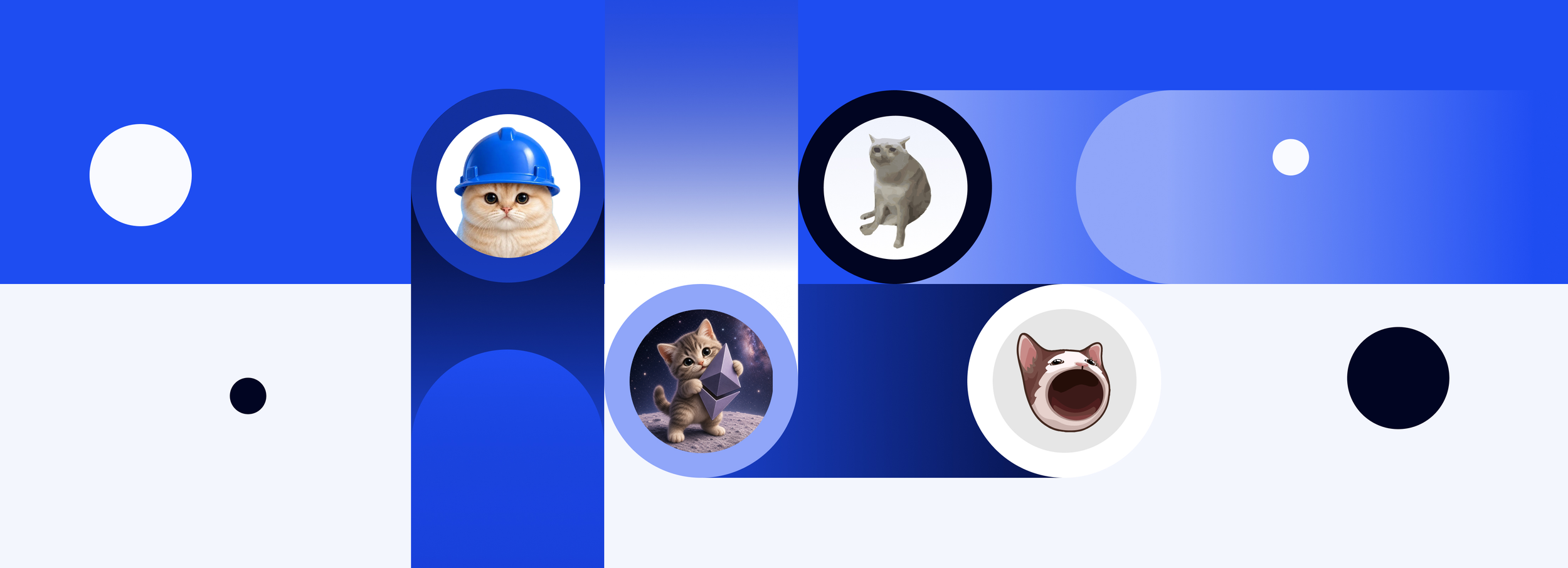
Cat-themed tokens form a recurring theme in crypto markets. Traders use the phrase “cat season” when capital moves into cat-themed tokens rather than a shared technology or product. The label became common in March 2024 after a Solana token called cat in a dogs world (MEW) reached a nine-figure market cap within days of launch.
Dog-themed coins still dwarf the category. Dogecoin launched in 2013. By August 2026 CoinGecko’s dog-themed grouping was worth about $14.9 billion across hundreds of tokens, while its cat-themed grouping was about $507 million. Later trackers put the cat group higher as new tokens appeared. On 7 September 2026 CoinGecko said the total market cap of cat-themed tokens had surpassed $1 billion during a rally in Anonymous Cat (ZCAT). Other dashboards in early to mid-September 2026 put the sector nearer $600 million to $811 million, depending on how many tokens they include.
The figures move quickly. Most of these tokens have no product beyond a meme, a ticker, and a liquidity pool.
From CryptoKitties to meme tokens
Cats entered crypto before memecoins. CryptoKitties launched on Ethereum on 28 November 2017 after a short closed beta. It was marketed as the first widely used Ethereum game. Players bought, sold, and bred unique digital cats stored as NFTs. Within days the game generated millions of dollars in trades. At one point it accounted for about 25% of Ethereum network traffic and contributed to congestion and higher fees.
Early sales were large by the standards of the time. Genesis, an early CryptoKitty, sold for about 247 ETH (then roughly $118,000). In 2018 a cat known as Dragon sold for 600 ETH, about $170,000 at the time. Dapper Labs was spun out of the original studio and later raised venture funding. Activity later fell. By 2022 daily sales were often under 100 and total daily value was frequently below $10,000.
CryptoKitties showed that digital cats could carry value on-chain. Later cat tokens reused the theme as fungible memecoins rather than collectible NFTs.
ETHCAT on Ethereum
ETHCAT is an ERC-20 token on Ethereum mainnet. The project presents itself as a community token based on the cat artwork used on ethereum.org. It is not affiliated with the Ethereum Foundation. Ownership is described as renounced and liquidity as burned. Total supply is 1 billion.
Pool data list the token as about two years old, consistent with a 2024 launch. Market capitalisation has stayed small relative to later cat coins. In mid-September 2026 sources put it around $217,000 to $270,000. An earlier snapshot had it nearer $480,000. That is the “traded flat” profile: long life, limited capitalisation, and little of the multi-hundred-million-dollar rotation seen on newer chains.
Popcat on Solana
Popcat (POPCAT) is a Solana token launched on 12 December 2023. It is based on a 2020 internet meme of a domestic short-haired cat named Oatmeal, shown with an exaggerated opening mouth. Supply is about 980 million tokens, almost all circulating. Liquidity-provider tokens for the original pool were burned.
Popcat was the first cat-themed token to reach a $1 billion market cap. Its all-time high was about $2.06 to $2.07 in November 2024, implying a peak near $2 billion. As of 11 September 2026 it traded near $0.048 with a market cap of about $47 million and 24-hour volume around $10 million to $11 million. That is a drop of more than 97% from the peak.
Cash Cat on Robinhood Chain
Cash Cat (CASHCAT) sits on Robinhood Chain, an Ethereum layer-2 that went live on 1 July 2026 and uses Arbitrum technology. Before the brokerage settled on the name Robinhood, its founders considered “Cash Cat”. An anonymous developer minted a token with that name shortly after mainnet. The project’s own site describes it as “fan fiction with a ticker” and states there is no affiliation with Robinhood Markets.
Tokenomics are simple: a fixed 1 billion supply, 0% transaction tax, and burned liquidity-provider tokens. Robinhood later listed the token in its app. Market-cap readings in August and early September 2026 ranged from about $86 million during a dip to figures around $147 million to $172 million on later snapshots. Some sector pages placed it at the top of the cat grouping. Prices remain volatile.
Separate Cash Cats NFT collections also exist. One 10,000-item set on Robinhood Chain had a reported collection market cap of about $1.86 million and a floor near 0.07 ETH in late August 2026. An ERC-404 style project used a buy-to-mint and sell-to-burn design for 10,000 crying-cat images. These NFT sets are distinct from the fungible CASHCAT token.
CATE, KATE, and the Doge replica attempts on Solana
On 26 July 2026 Atsuko Sato, owner of Kabosu, the Shiba Inu behind the original Doge meme, posted a kitten video. Communities on Pump.fun launched tokens framed as the cat successor to Dogecoin. The main token that gained size is Catecoin (CATE). Sato later said the circulating CATE tokens had no connection with her and that her post had been used without authorisation.
CATE launched as a fair launch with mint and freeze authority revoked and no transfer tax. Circulating supply is about 964 million after burns. On 11 September 2026 community and DEX dashboards put the market cap near $48 million to $50 million, with more than 120,000 holders and 24-hour volume often above $13 million. It had traded above $50 million after a sharp rebound on 9 September 2026.
Many other Solana tokens reused the KATE ticker or similar branding, often as a “sister”, “black cat” or “evil twin” of CATE. Public pool pages show typical market caps of a few thousand dollars, thin liquidity and short lifespans. None of those KATE launches replicated Dogecoin’s scale. The pattern is common on Solana: cheap token creation, repeated tickers, and a small number of names that attract lasting volume.
BASECAT on Base
BASECAT is a Base-network meme token launched around 15 August 2026. Its image is a cat in a blue construction helmet. Supply is 1 billion. The project is community-run and is not an official Coinbase token, though Coinbase later offered spot trading.
Early pools were thin relative to price. The token rose several thousand per cent from launch. On 6 September 2026 its market cap briefly exceeded $83 million on some feeds before falling. By 11 September 2026 CoinMarketCap and related sources put it near $23 million to $25 million, with tens of thousands of holders and daily volume often in the tens of millions of dollars.
Toshi (TOSHI), another Base cat token named after Coinbase chief executive Brian Armstrong’s cat, was still near $47 million on 11 September 2026. It is older than BASECAT and remains one of the larger Base-native cat names.
ZCAT and a tax paid in Zcash
Anonymous Cat (ZCAT) is a Solana Token-2022 memecoin launched in August 2026 through StonkFun. It trades against Zcash rather than SOL. Every transfer carries a 3% tax. Most of that fee is converted into ZEC and sent to wallets holding at least $20 of ZCAT. By 7 September 2026 the project dashboard showed about 2,320 ZEC distributed, then worth roughly $2.8 million, across more than 470,000 payouts. Those rewards come from other traders’ transfers, not from an external business.
Maximum supply is 1 billion, with about 969 million circulating. Market cap readings around 7 September 2026 were near $124 million. By 10–11 September sources put it nearer $85 million to $101 million. The token is separate from Zcash itself.
How the chains differ
Ethereum hosted CryptoKitties and later ETHCAT. Fees are higher, so low-cap meme launches are less common than on newer networks.
Solana dominates high-frequency meme issuance through Pump.fun and similar pads. Popcat, MEW, CATE, and ZCAT all used that environment. A DexScreener sweep on 23 August 2026 found 72 cat-named tokens with pools less than 60 hours old across several chains, many of them on Solana.
Base, Coinbase’s layer-2, hosts Toshi and BASECAT.
Robinhood Chain gave CASHCAT a native venue tied to a discarded company name.
BNB Chain has also hosted cat tokens, including a Simon’s Cat brand token launched in August 2024.
MEW, the token that helped popularise “cat season” in 2024, traded near a $35 million market cap in mid-September 2026, far below its 2024 peak near $1 billion.
What the data show
Cat tokens now appear on most major smart-contract chains. A few names hold most of the value. In September 2026 those included CASHCAT on Robinhood Chain, ZCAT, and CATE on Solana, Popcat on Solana, Toshi, and BASECAT on Base, plus older names such as MOG. Hundreds of other tickers exist at caps below $1 million, and many last only hours or days.
Market-cap totals for the theme are inconsistent because aggregators include different lists. A figure of about $500 million to $800 million for listed cat tokens was typical in August and early September 2026, with a brief print above $1 billion during the ZCAT move. Individual tokens can double or halve in a day. Ownership of a meme, a viral post or a brand name does not confer control of the token, as the CATE, and CASHCAT cases show.
CryptoKitties remain the historical starting point: unique cats on Ethereum in 2017. The later “season” is a rotation of fungible tickers that reuse the same animal, usually without the breeding game or the collectible design that began the story.
Risk Disclosure
Trading or investing in crypto assets is risky and may result in the loss of capital as the value may fluctuate. VALR (Pty) Ltd is a licensed financial services provider (FSP #53308).
Disclaimer: Views expressed in this article are the personal views of the author and should not form the basis for making investment decisions, nor be construed as a recommendation or advice to engage in investment transactions.
